
Though most experts remain bullish on the banking space, they suggest investors buy only those banks whose NPAs are at a manageable level of 3% to 4% and there is credit growth or earnings visibility.


Recpaitalising banks through taxpayers' money will not solve the NPA problem.

Among Sensex components, shares of Reliance Industries, India's largest company by market value, stole the show by surging 1.61 per cent to their highest in over three months.

Moody's said the asset quality of the banks will remain under pressure.

On the Sensex chart, IndusInd Bank, SBI, Dr Reddy's, NTPC, ICICI Bank, HCL Tech and Bajaj FinServ emerged as major laggards.

Most of the buses run by Telangana State Road Transport Organisation are also off the roads

Bank loan defaults rose to Rs 74,685 crore (Rs 746.85 billion) at the end of March 2010, with non-performing assets of public sector banks reaching Rs 57,301 crore (Rs 573.01 billion), Parliament was informed on Tuesday.

A local official confirmed the incidents but said the causes of these suicides were yet to be ascertained.
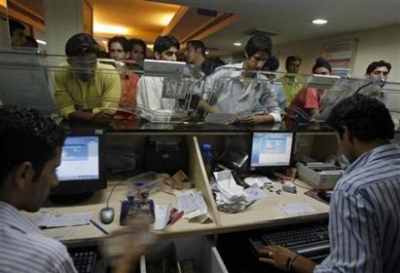
Analysts, however, said the timing of the infusion was good.
Many PSU banks had recently cut interest rate on loans for two-wheelers and consumer durables.

Bad loans of PSU banks rose by 28.5 per cent.

The S&P BSE Sensex and the Nifty50 have hit record highs amid the poll outcome-triggered bull frenzy at the bourses. Most analysts feel that the indices are on course to rise further over the next few months - till the general elections - albeit amid intermittent corrections - largely triggered by global developments. Bharatiya Janata Party's (BJP's) win in the three state elections of Madhya Pradesh (MP), Rajasthan and Chhattisgarh, analysts at Jefferies believe, reinforces the consensus expectations of a Modi win 2024 national elections with a greater likelihood of over 300 seats for the BJP.

The 30-share BSE gauge climbed 465.14 points or 0.80 per cent to finish at 58,853.07. During the day, it jumped 546.97 points or 0.93 per cent to 58,934.90.

With short-term rates firming up due to tight liquidity conditions, Indian corporates are opting to borrow long term to take advantage of the attractive rates by locking them in these uncertain times. The banking system has a liquidity deficit of over Rs 2 trillion. According to market participants, engineering conglomerate Larsen & Toubro (L&T) raised Rs 1,500 crore through 10-year bonds in December 2024.

The conciliation talks between UFBU and Indian Banks Association held in Mumbai moved a step ahead positively after the IBA offered a 9.5 per cent hike on pay slip cost and hold another round of talks on January 27, UFBU national Convenor M V Murali told PTI in Tirupati over phone.
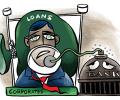
Let all the stakeholders, especially the government, remember that if the Make in India lion needs to roar and rise again, it won't happen unless India Inc rises too, points out Shekaar Subramanian.

The Sensex jumped nearly 900 points and the Nifty rallied over 272 points on Friday, bouncing back from the previous day's fall, following a positive trend in global equities and fresh foreign fund inflows. The BSE Sensex rallied 899.62 points or 1.53 per cent to end at 59,808.97 after starting the trade on a positive note. During the day, it jumped 1,057.69 points or 1.79 per cent to 59,967.04.

'They are ideal for short-term financial goals like children's education or a down payment for a house.' 'They are also useful for transitional savings, such as during job switches or while starting a business.'

Jefferies has identified 11 stocks set to benefit from long-term macro trends like capital expenditures, government manufacturing initiatives, and financialisation.

Fitch Ratings on Monday said the plan to privatise two state-owned banks in the current financial year ending March 2022 could face delays amid renewed challenges for the Indian banking sector due to the second wave of Covid-19. The government in the Budget announced plans to privatise two public-sector banks. NITI Aayog has been entrusted with the task of selecting the banks and one general insurance company for the privatisation.

The Reserve Bank of India's (RBI's) latest order on unsecured loans is set to hit the banking sector's growth in the near-term, cautioned analysts, as they see banks slowing down on aggressive retail lending. Besides, cost of funds for non-banking finance companies (NBFC) is expected to inch up as banks will pass on higher capital charge to NBFCs. "We believe the fallout of the RBI action will be mainly on growth, given the rising dependence on unsecured retail loans and lending to NBFCs for growth.

Non-Performing Assets are a wake-up call for public sector banks.

Govt's divestment plans encourage funds to bet big on state-owned firms.

Wage revision in PSU banks is done every five years.

Jaitley said that the banks have to play an important role in achieving the higher growth rate.
Private sector banks are way behind their PSU peers when it comes to opening financial inclusion accounts under the Prime Minister's Jan Dhan Yojana

Among the Sensex firms, Axis Bank, Power Grid, Maruti, State Bank of India, Tata Motors, ITC, Nestle and Mahindra & Mahindra were the major gainers. Bajaj Finance and Larsen & Toubro were the laggards.

His statement assumes significance in the light of scams in the state-owned banks.

Since March 2020, when the Nifty50 plummeted to 7,511 following the announcement of a nationwide lockdown, the stock market has been on an upward trajectory. Over the next four years, the major market index has delivered a remarkable compounded annual growth rate (CAGR) of over 31.5 per cent. In the past year alone, the Nifty50 has gained by 27 per cent, hitting a succession of record highs.

'The CM kept his cool, but his adviser was liberal with filthy language.' Tamal Bandyopadhyay recreates the diary of a general manager in a public sector bank, providing a glimpse of how they balance their work and life.
BSE PSU index rallies 10% in one month; nearly a third of the stocks on the index has gained 20% over the period
Reserve Bank has lowered interest rates by 0.50 per cent since January 2015.
Last year, the government had announced to infuse Rs 70,000 crore in PSU banks.

The financial position of India's public sector banks (PSBs) has deteriorated sharply over the past financial year.
"Cost of funds is still high, so once it comes down, we will reduce interest rates," HDFC chairman Deepak Parekh said. Parekh's comments came two days after Finance Minister P Chidambaram said 'competition from PSU banks will force lenders in private sector to cut interest rates sooner than later'.
Customers using e-commerce websites are young and techno-savvy.

'It is human nature to get angry and annoyed when you are inconvenienced.' 'But we were able to enroll a few of our customers as 'bank mitras', who with my staff made sure that the queues were orderly and coupons were given to all the customers who wanted to withdraw or deposit money.'
The government is open to providing more capital than that announced in the Budget.

Unlike any other national asset, which is typically sold to the highest bidder, the profile of the bidder is the most important criterion for a licence to bank, and even for acquiring more than 5 per cent stake, explains Tamal Bandyopadhyay.
